


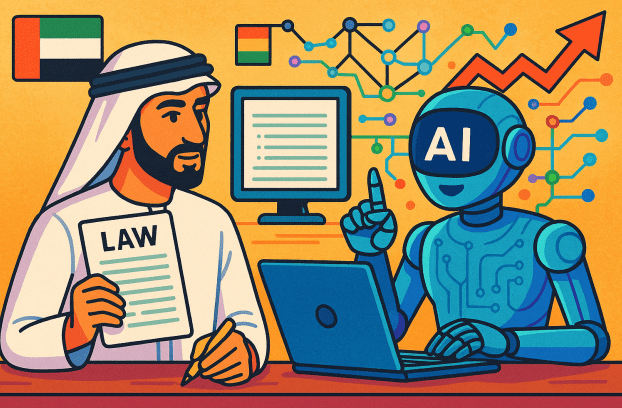
The United Arab Emirates (UAE), which is emerging as an “AI big hand” by investing heavily in artificial intelligence (AI), is the world’s first to enact laws using AI.
According to the Financial Times (FT) on Sunday, the UAE has announced its plan to use AI to enact new laws and review and revise existing laws. To this end, UAE officials have approved the creation of a new cabinet agency, the Regulatory Information Office, which will oversee AI legislation. “Many governments are trying to use AI to summarize laws or improve public services,” the FT said. “However, there have been no cases where AI directly proposes to revise laws by analyzing government and legal data.”
The UAE expects AI to cut legislative time by 70 percent. On top of that, the UAE government plans to build a huge database of federal laws and rulings to track the impact of laws on the population and economy. Dubai ruler and UAE Vice President Sheikh Muhammad bin Rashid Al Maktoum said in local state media that “the new legislative system driven by artificial intelligence will change the way we enact laws by making the legislative process faster and more accurate.”
The AI legislation system is drawing more attention given that the UAE is recently making a large investment in AI. The UAE founded MGX, an investment organization dedicated to AI, and started to create a $30 billion AI infrastructure fund with BlackRock, the world’s largest asset manager. Ronnie McDalia, a professor at Copenhagen Business School, called the UAE’s plan “very bold” and “it seems to be based on its ambition to basically make AI a kind of co-legislator.”
However, it is still unclear which AI system the UAE will use. Some say that it is important to have protective measures as there may be risks to legislation through AI. Professor Vincent Straub of Oxford University pointed out that while the AI model is impressive, “they will continue to provide false information and have problems with reliability and robustness.”
JENNIFER KIM
US ASIA JOURNAL

