


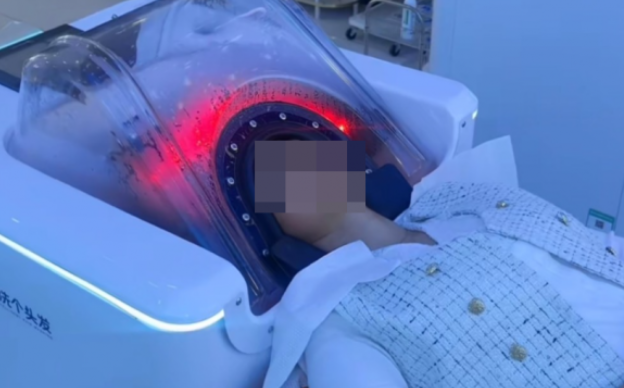
The device continues to adjust the water spray position to clean the scalp and hair, and it is known that the cost is currently about 3,700 won per session on average.
According to local media such as the Guangzhou Daily on the 15th, stores that use AI devices to wash their hair have recently begun to appear in Guangzhou, a city in southern China.
It is a simple method that works when a customer lies on a massage bed and puts his or her head into the device. After checking the condition of the customer’s scalp using the device, the customer automatically cleanses his or her hair when he or she chooses an oily or dry shampoo.
It is not an unmanned store because the device continuously adjusts the water spray position to clean the scalp and hair during operation. The staff prepares towels and earplugs and helps with the before and after process.
It takes a total of 13 minutes, including two shampoos, one treatment, and seven rinses. The cost was 9.9 yuan during the initial promotion period, but now it is reported that the average is 19 yuan per session.
Local Internet users shared their experiences on social media (SNS) Weibo (Chinese version of X), and they were also concerned that jobs would decrease as more stores replaced simple tasks with machines.
Internet users showed various reactions such as “My hair was washed cleaner than I thought it would be,” “It’s not good that I have to dry my hair,” and “It was interesting to automatically adjust the temperature of the water, but it didn’t exactly scratch where it was itchy.” China is using AI in various fields. Last year, the Chinese city of Beijing issued a permit for a multitasking cooking robot for the first time.
This artificial intelligence (AI) robot developed by startup Enco Smart can cook various kinds of dishes, unlike robots that only perform single tasks such as making pancakes or boiling noodles. It also keeps learning how to create new menus or avoid safety risks depending on the working environment.
“AI is an inevitable trend in the food and beverage industry,” a Beijing city official said. “Before issuing the permit, we reviewed the product strictly to ensure it complies with national food safety regulations.”
“Our robot can learn through algorithms that increase heating efficiency to make food more delicious,” said Tianyan, head of EcoSmart development. “Robot sensors monitor oil temperature to avoid fire danger.”
China’s Securities News pointed out that it indicates that AI robots have officially entered the restaurant service sector, while other local media reported that robots have been able to legally open restaurants.
SALLY LEE
US ASIA JOURNAL

